
Electronic Wills Aren’t Valid: Stick to Pen and Paper
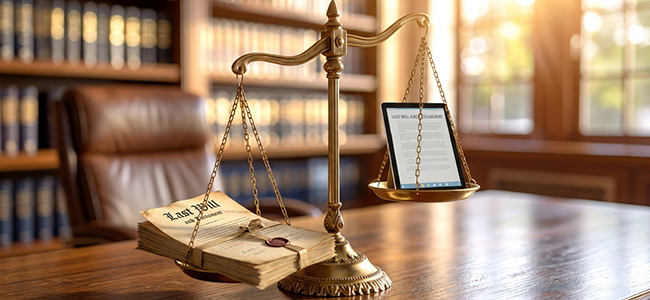
“Let's choose executors and talk of wills.” (William Shakespeare in Richard II)
You may have read one of the many online articles about an electronic will being validated recently by the High Court.
Don’t be misled into thinking that electronic wills are now valid as a matter of course – they most certainly are not. Unless and until our Wills Act is updated to say otherwise, not leaving a written and signed will complying with all the Act’s formalities exposes your grieving loved ones to the risk of a hard-fought court battle at the worst possible time.
What makes a will valid?
Only a written, signed will complying with all legal formalities will be accepted by the Master of the High Court. If you leave only a non-compliant will, your loved ones will have to ask the High Court to validate it.
What are these formalities?
You must sign the will on the last page (at the end of the document) in the presence of two witnesses who must also sign as such.
If there is more than one page to the will, you must sign every page. Although it’s not strictly necessary for your witnesses to also sign all the pages, it’s good practice for them to do so.
Your witnesses must be “competent”, that is, at least fourteen years old and mentally competent.
Don’t let any of your heirs or beneficiaries either sign as a witness or write out any part of the will, as that will disqualify them from inheriting.
At this juncture you may be thinking: “But it’s 2026! Aren’t electronic documents and signatures as valid as physical ones?” Nope, unfortunately not when it comes to wills.
ECTA and electronic signatures
The Electronic Communications and Transactions Act (ECTA) says that generally, with only a few exceptions and requirements, electronic signatures and documents are valid and binding. But – and this is critical – it specifically states that they “must not be construed as giving validity to the execution, retention and presentation of a will or codicil [addendum to a will] as defined in the Wills Act.”
In other words, pen and paper are still non-negotiable requirements when it comes to wills.
Which begs the next question. What happens if for some reason your will is found to not comply with these formalities?
What your heirs must prove to overcome non-compliance
Fortunately, the Wills Act does allow our courts to look beyond technical non-compliance so as to give effect to the deceased’s true intentions.
In such cases the heirs will need to prove:
That the document was drafted or executed by the deceased.
The maker of the document must, naturally, be dead.
The person making it must have intended that document to be his or her will.
That’s the law underlying the Court’s decision in this dispute, so let’s see how it all played out in practice.
A bitter fight over two conflicting wills, one written and one electronically signed
The deceased, at the time a Constitutional Court Justice, made a will in 2014. She then made another in 2021.
In both wills, she had named her children, a granddaughter, and her life partner as her heirs and beneficiaries. Critically, in the 2014 will she had left 100% of her Magersfontein property to her life partner. But in the 2021 will she changed that, leaving the property to her children in equal shares.
Perhaps unsurprisingly, the life partner challenged the validity of the 2021 will, and her children and granddaughter in return asked the High Court to instruct the Master of the High Court to accept it as valid.
It became clear that the 2021 will was formally defective in two respects:
All three signatures (those of the deceased and her two witnesses) had been appended electronically
The deceased’s signature was in the wrong place on the document.
Critically, however, the life partner did not dispute the evidence of the two witnesses to the will that the deceased had, after a phone call, emailed them to ask that they append their signatures to the will electronically. He also accepted that the will reflected the deceased’s true intentions and that she had intended it to be her final will.
Finding on this evidence that the deceased had given direct instructions for the drafting of the 2021 will, and that she had indeed accepted that will as her own, the Court instructed the Master of the High Court to accept it as her will.
There’s a very clear lesson for us all here…
Pen and paper rule!
Electronic wills, and electronic signatures on wills, are not automatically valid. The only way to protect your loved ones from all the delay, confusion and cost of a High Court application to get an electronic will condoned is to leave a written, signed will that complies with all the Wills Act’s formalities.
We’re here to help!
Disclaimer: The information provided herein should not be used or relied on as professional advice. No liability can be accepted for any errors or omissions nor for any loss or damage arising from reliance upon any information herein. Always contact us for specific and detailed advice.
© LawDotNews